
Audit Overview
Your store's untapped revenue potential — and how to unlock it
Why We Created This Audit
We analyzed https://www.ottostore.com/ the same way we've audited 350+ e-commerce stores — looking for the specific gaps between your current experience and what top-performing Fashion & Apparel stores deliver. Every finding in this report is a revenue opportunity backed by industry data and competitive benchmarks.
What We Analyzed
- UX & Conversion Design12 findings
- Performance & Speedvs 4 competitors
- Technology & App StackPlatform + 5 apps
- Industry BenchmarksFashion & Apparel
Pages Analyzed
- Homepage1 findings
- Collection Pages3 findings
- Product Pages (PDP)4 findings
- Cart & Checkout4 findings
 This audit was prepared by Growisto — a CRO-led Website development team behind 167% conversion growth for Atomberg, 46% CR lift for TyresNmore, and 350+ e-commerce projects.
UX & Conversion Findings
Page-by-page analysis with visual comparisons against top Fashion & Apparel stores
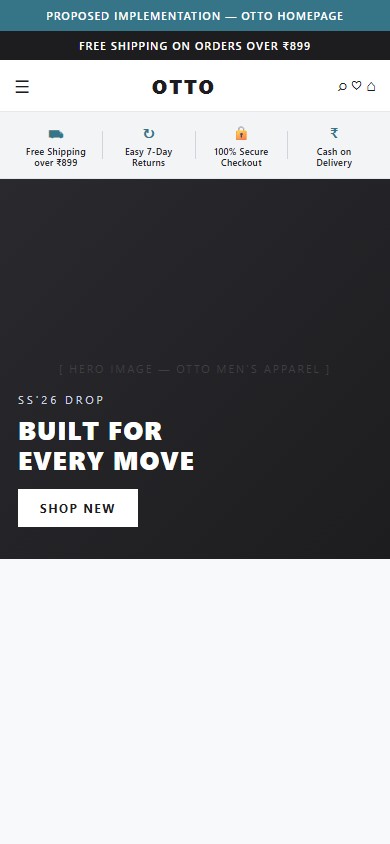
- Otto's homepage opens directly with the hero banner — no trust strip communicating returns policy, shipping terms, secure checkout, or payment options.
- First-time shoppers on a Shopify D2C site at this price band typically need 3–5 trust signals above the fold; their absence pushes that justification work onto the user.
- Otto already runs free shipping above ₹899, 7-day returns, and Gokwik secure checkout — none of which are surfaced where they would do the most work.
- Add a slim icon strip directly under the navigation: 'Free Shipping over ₹899', 'Easy Returns', 'Secure Checkout', 'COD Available'.
- Keep the bar visually subtle (light grey background, 36–44px tall) so it complements the hero rather than competing with it.
- Reuse the same bar on PLP, PDP and cart for consistent reassurance throughout the funnel.
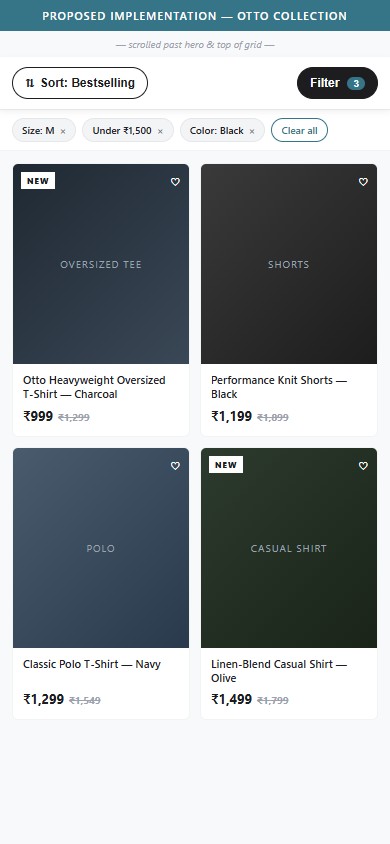
- Otto's filter and sort controls live at the top of the collection page and disappear after the first scroll — users who want to refine mid-browse have to scroll back to the top.
- On a 100+ SKU collection grid this creates a visible disengagement point: shoppers either give up on refining or bounce.
- Sticky filter/sort is a standard pattern across fashion D2C in India (Snitch, Bewakoof, Myntra) — its absence reads as outdated UX.
- Pin the filter and sort row to the top of the viewport once the user scrolls past it on mobile and desktop.
- Keep the sticky version compact (single row, 48–56px tall) so it doesn't eat browse real estate.
- Match the existing PLP visual language so the sticky variant feels like a continuation, not a new bar.
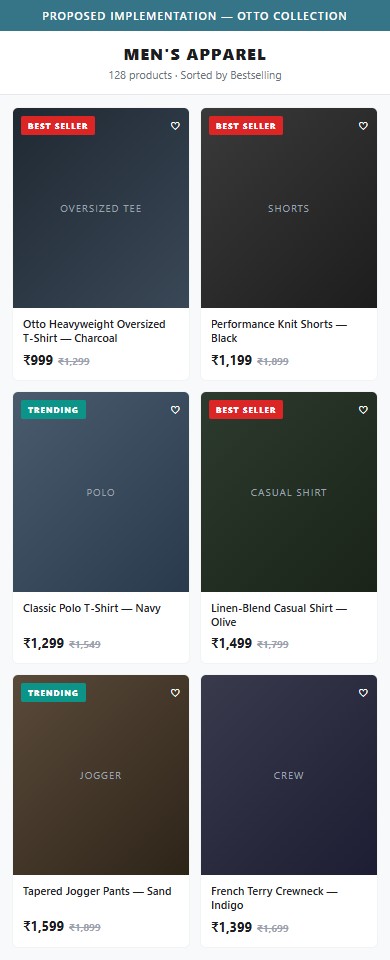
- Otto's PLP tiles carry only a 'NEW' chip on selected products — no 'Best Seller', 'Trending', or 'Most Loved' badges anywhere.
- The grid is ordered by recency, so high-converting products are not prioritised — shoppers have to dig to find what's working.
- Demand signals (badges + ranking) reduce decision load for first-time visitors who don't know the catalogue.
- Tag the top 10–15% of SKUs by 30-day sales with a 'Best Seller' badge, and the top 5–10% of fastest-growing SKUs with 'Trending'.
- Default the PLP sort to 'Bestselling' so trending products land in the first two rows.
- Refresh the badge assignment via a Shopify metafield + scheduled job so badges stay accurate.
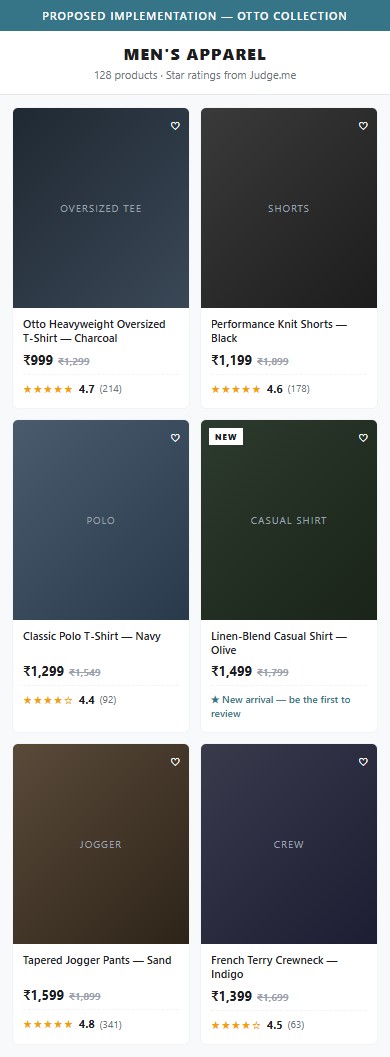
- Otto's product tiles on the homepage and PLP show image, title, price and a 'NEW' chip — but no star rating or review count.
- Judge.me is installed and reviews exist on PDPs, but tile-level aggregation is missing, so social proof never surfaces at the browse stage.
- On mobile, where shoppers scan 8–12 tiles per scroll, the absence of any quality signal forces price + image to do all the conversion work.
- Surface aggregate rating (e.g. ★ 4.5) and review count under the price on every tile across homepage carousels and PLP.
- Pull the data from Judge.me's product review metafield so it stays dynamic.
- Hide the rating chip on tiles with under 10 reviews to avoid an empty-looking start state — show 'New' instead.
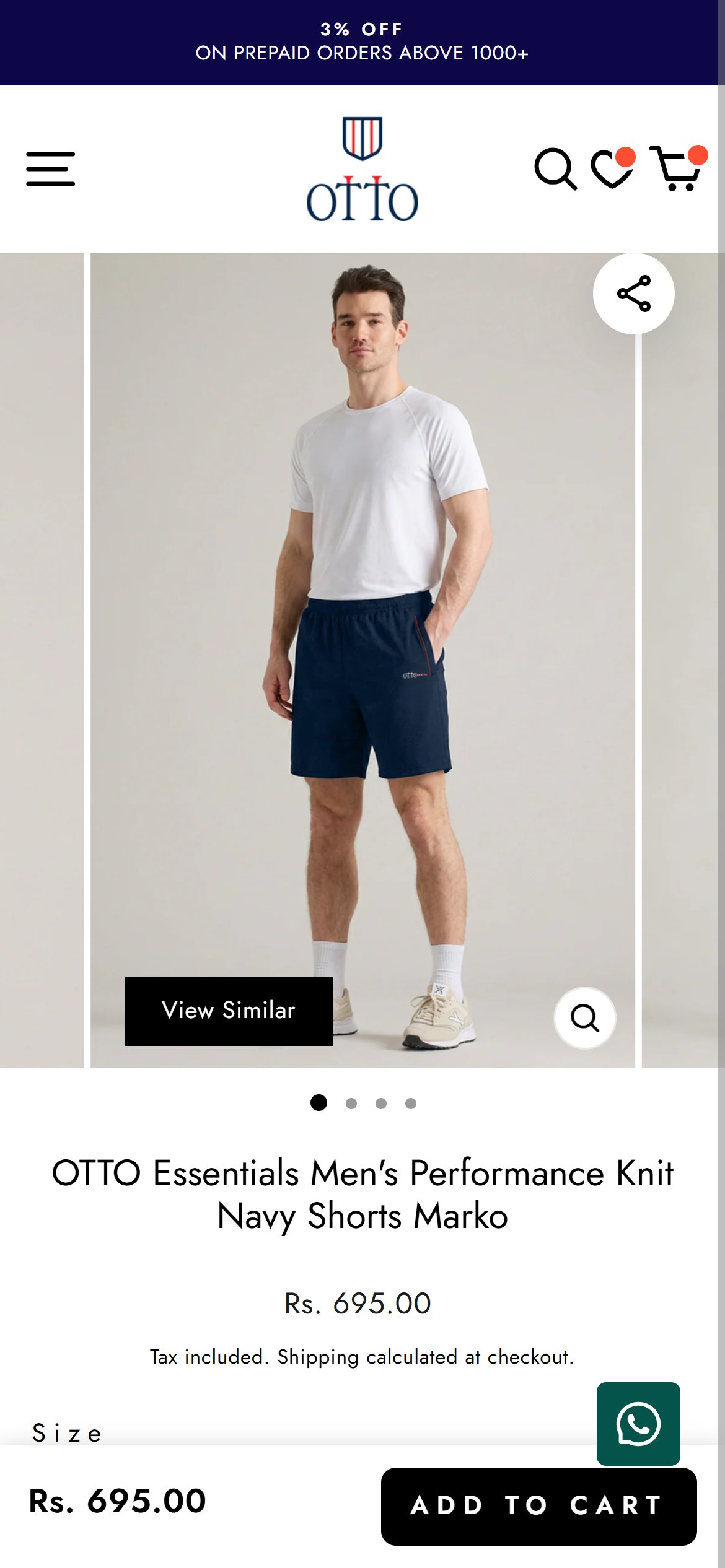
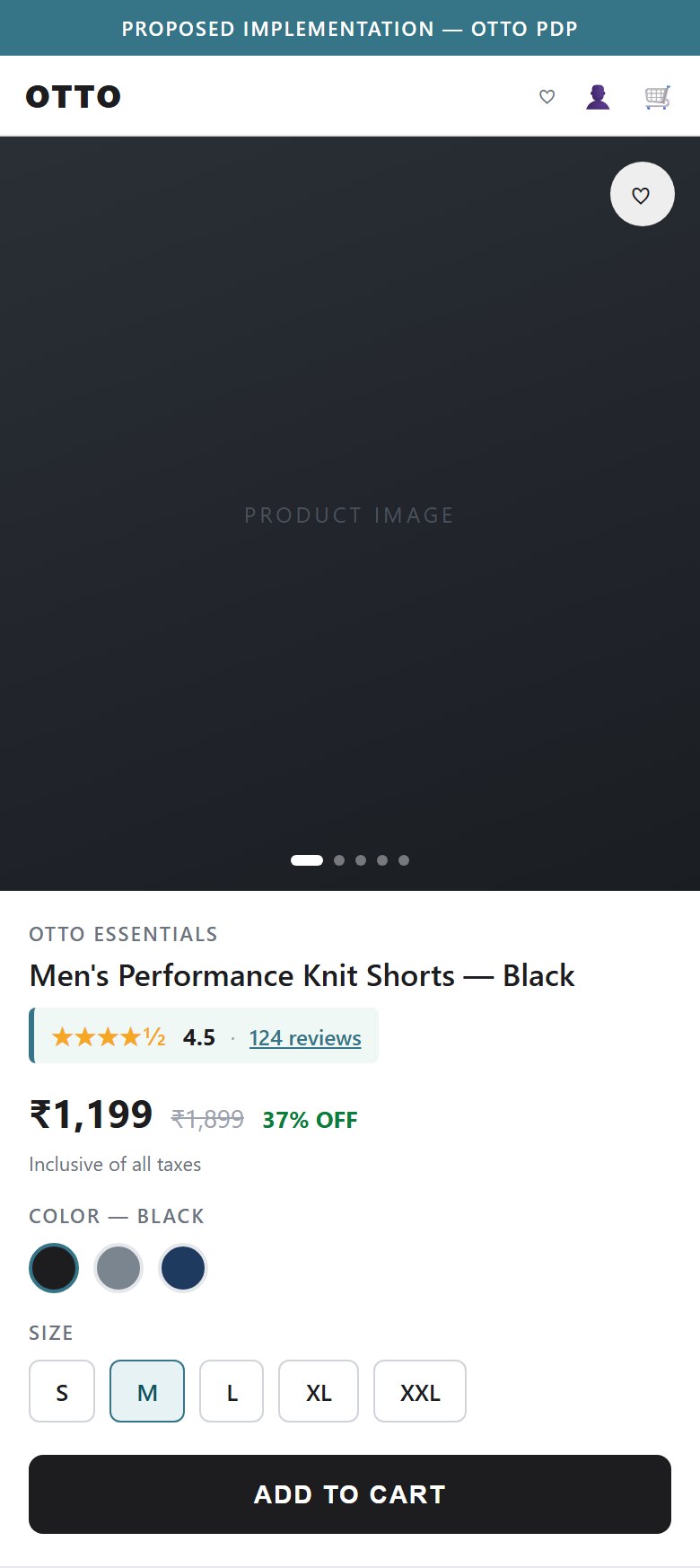
- The first PDP fold (title, price, MRP, color swatch, sizes, ATC) shows no aggregate rating, review count, or 'X people bought this' signal.
- Reviews exist further down the page (Judge.me widget present), but the fold-1 decision is made without that proof.
- 7/10 benchmark fashion stores show stars + count above the fold — for first-time visitors arriving from paid ads, this is the single highest-leverage trust signal.
- Render a one-line 'Stars + (N reviews)' element directly beneath the product title using the Judge.me preview badge already deployed.
- Click the rating to scroll-anchor to the full reviews section — keeps the fold clean while letting interested users dig in.
- For products with <10 reviews, suppress the count and show 'New arrival' instead so empty review badges don't tank conversion.
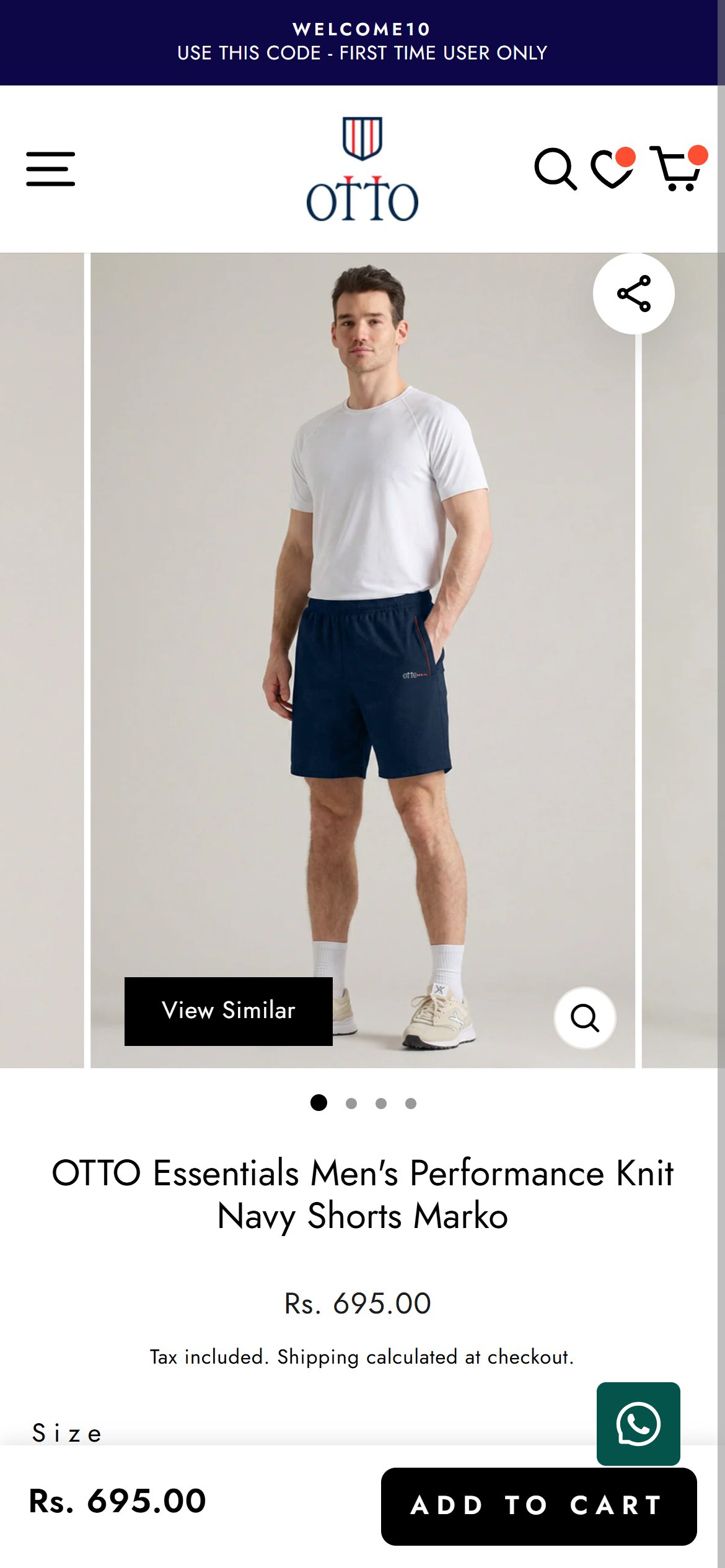
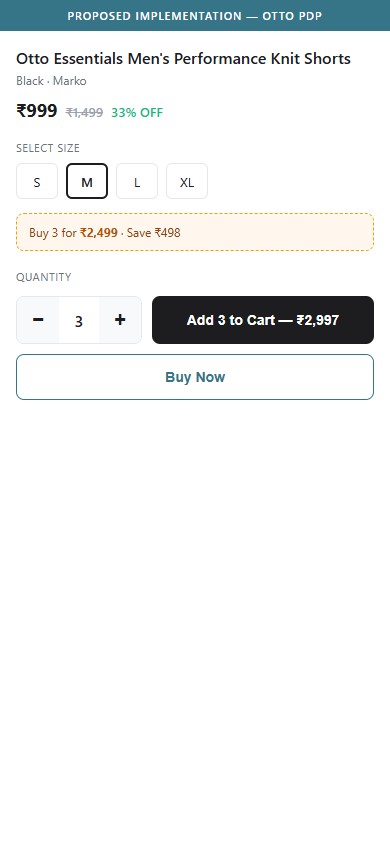
- The PDP has size and color selectors but no quantity stepper — shoppers can only add 1 unit per ATC click.
- For staples (innerwear, t-shirts, loungewear), shoppers commonly want 2-3 units of the same SKU; today they must add once, go to cart, then increment.
- Each extra step before cart introduces drop-off — and the cart-page quantity update breaks the natural intent flow.
- Add a compact +/- stepper (default 1, min 1, max 10) directly to the left of the Add to Cart button on the PDP.
- When stepper > 1, change the ATC label dynamically: 'Add 3 to Cart — ₹2,997' to confirm the commitment.
- Add a 'Buy 3 for ₹2,499 (Save ₹500)' inline bundle nudge above the stepper for staple categories like innerwear and tees.
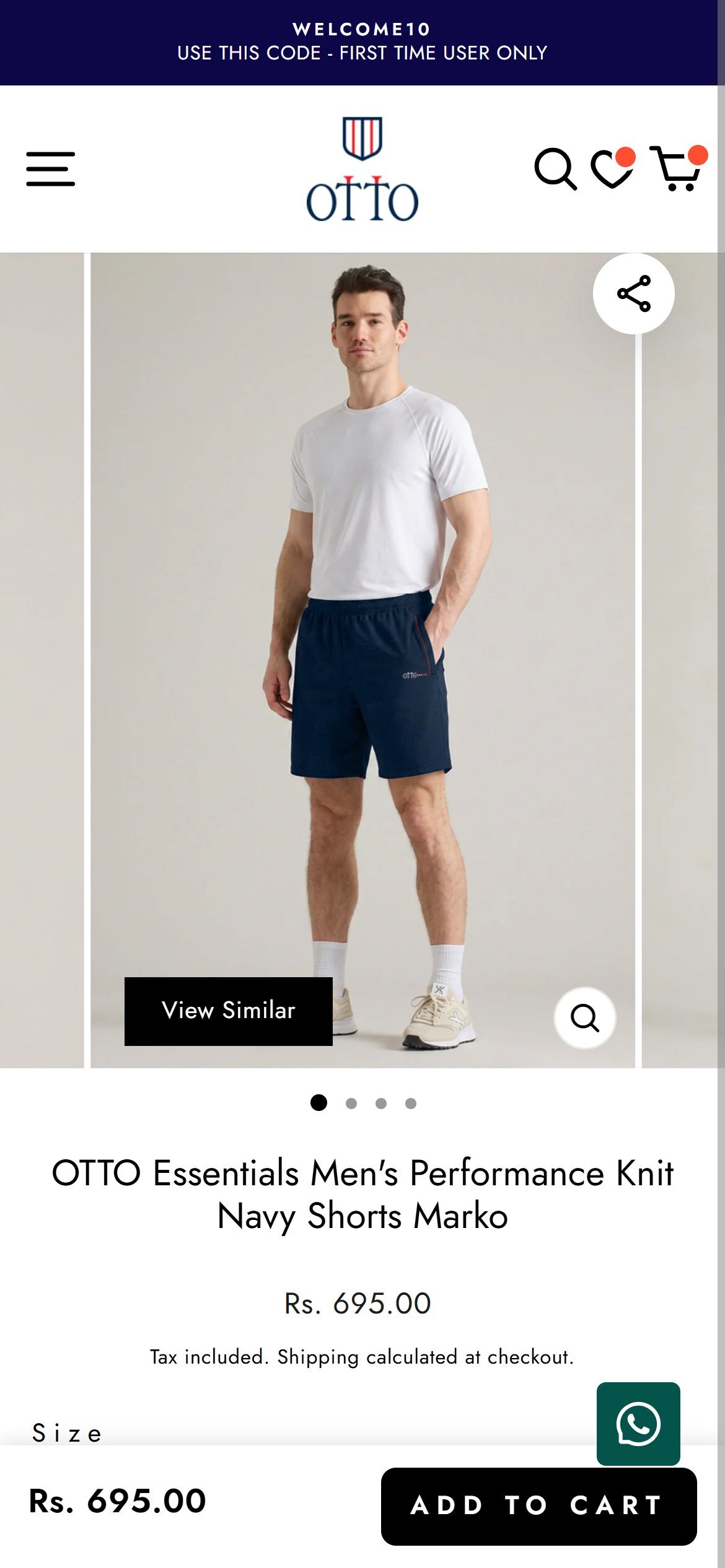
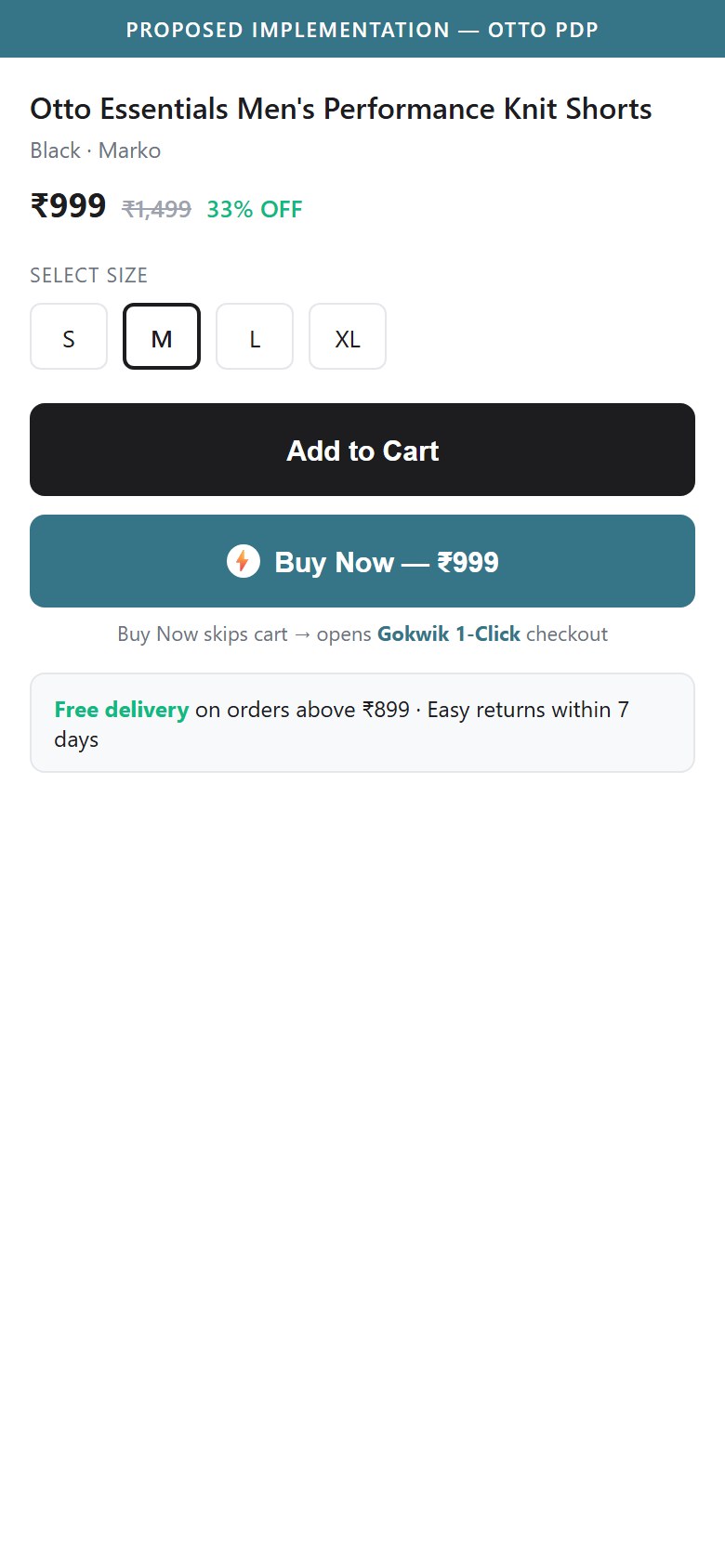
- Otto's PDP exposes only an Add to Cart button — there's no 'Buy Now' express path that skips the cart for high-intent single-SKU buyers.
- Gokwik checkout is installed (kwikpass detected), so a Buy Now click can route directly into the Gokwik 1-click flow for returning customers.
- For mobile-led traffic where a shopper picked size + color and is ready to convert, the extra cart-page step is pure friction.
- Add a 'Buy Now' button immediately below Add to Cart, styled in brand secondary color so it doesn't compete with ATC visually.
- Wire Buy Now to skip cart and open Gokwik/native checkout with the configured variant pre-loaded.
- For repeat customers (logged in via Gokwik kwikpass), expose 'Buy with 1-Click' phrasing to reinforce the speed promise.
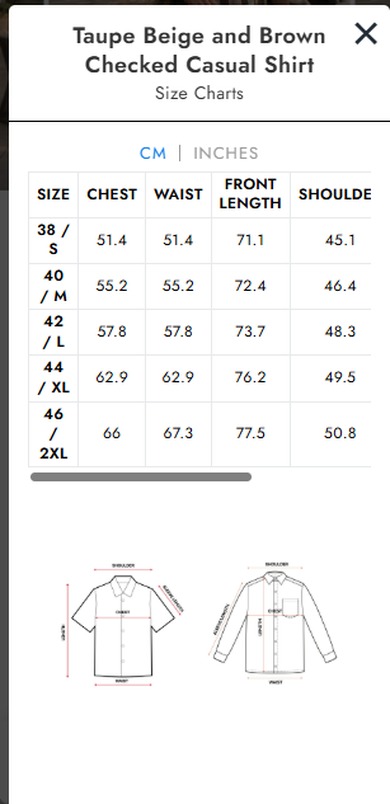
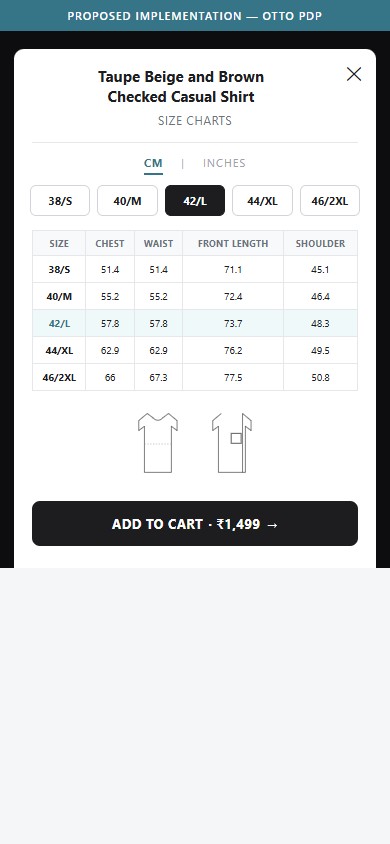
- Otto's PDP opens a dedicated size-chart modal (chest / waist / front length / shoulder, with CM ↔ inches toggle) whenever a shopper taps 'Size Chart' — useful for fit confirmation.
- Inside that modal there's no size selector and no Add-to-Cart button — the shopper has to close it, scroll back to the PDP body, pick a size, find ATC, and tap a second time.
- Every additional step in a fit-confirmation flow costs conversion on mobile — the modal is the *exact* moment of intent, but Otto routes that intent away from the action.
- Add a size selector row (S / M / L / XL / 2XL pills) at the top of the size-chart modal so shoppers can pick the right size with the measurements visible.
- Add a prominent 'Add to Cart · ₹{price}' button at the bottom of the modal — disabled until a size is selected, then activated with the live price.
- Keep the CM/inches toggle and the measurement table — they earn their place; the change only adds two interactive elements that turn the modal into an end-to-end fit→cart step.
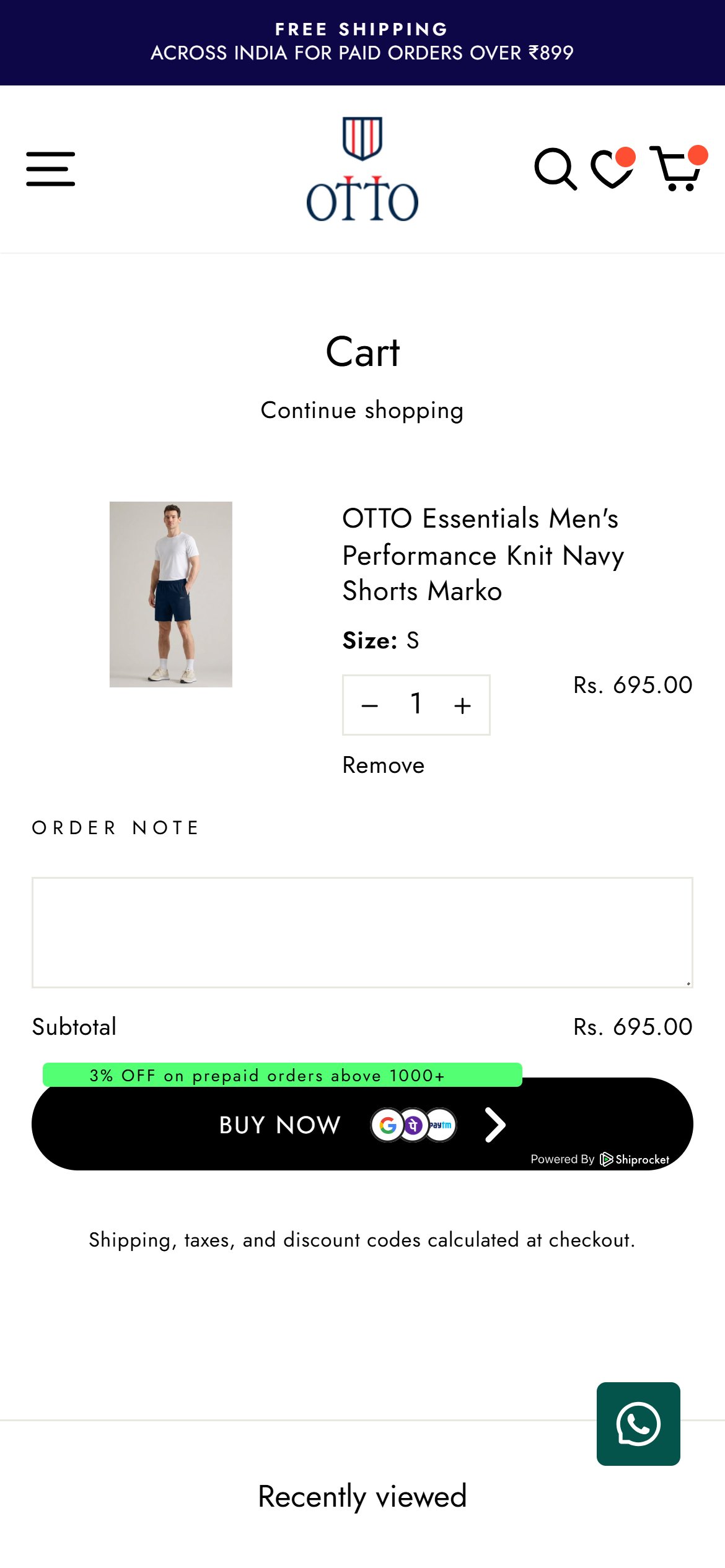
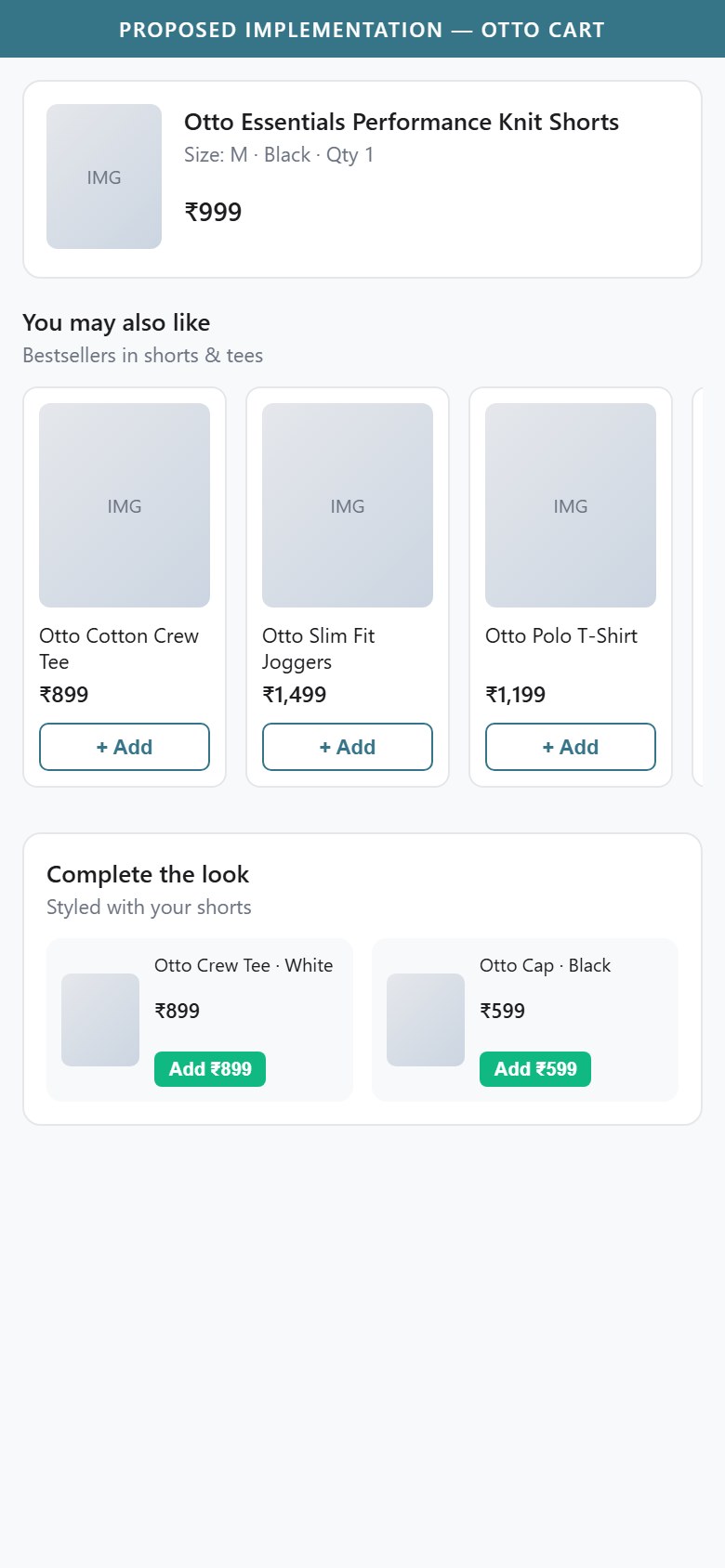
- The /cart page shows only the added item, quantity controls, subtotal, and a Checkout CTA — zero recommendation surfaces.
- Cart cross-sells in fashion typically lift AOV 12-20% — at Otto's ~₹1,300 AOV, even a 10% AOV lift is meaningful on every order.
- 7/10 benchmark stores run cross-sell in the cart drawer or page; in India fashion specifically, 4/5 stores do it.
- Add a horizontal 'You may also like' scroller below the cart line items with 4-6 Bestseller SKUs from the same category as the cart item.
- For apparel, add a 'Complete the look' module showing 2 curated SKUs — e.g. trouser added → show matching shirt + belt.
- Wire one-click 'Add' on each recommendation card; refresh cart inline (no full reload) to keep momentum.
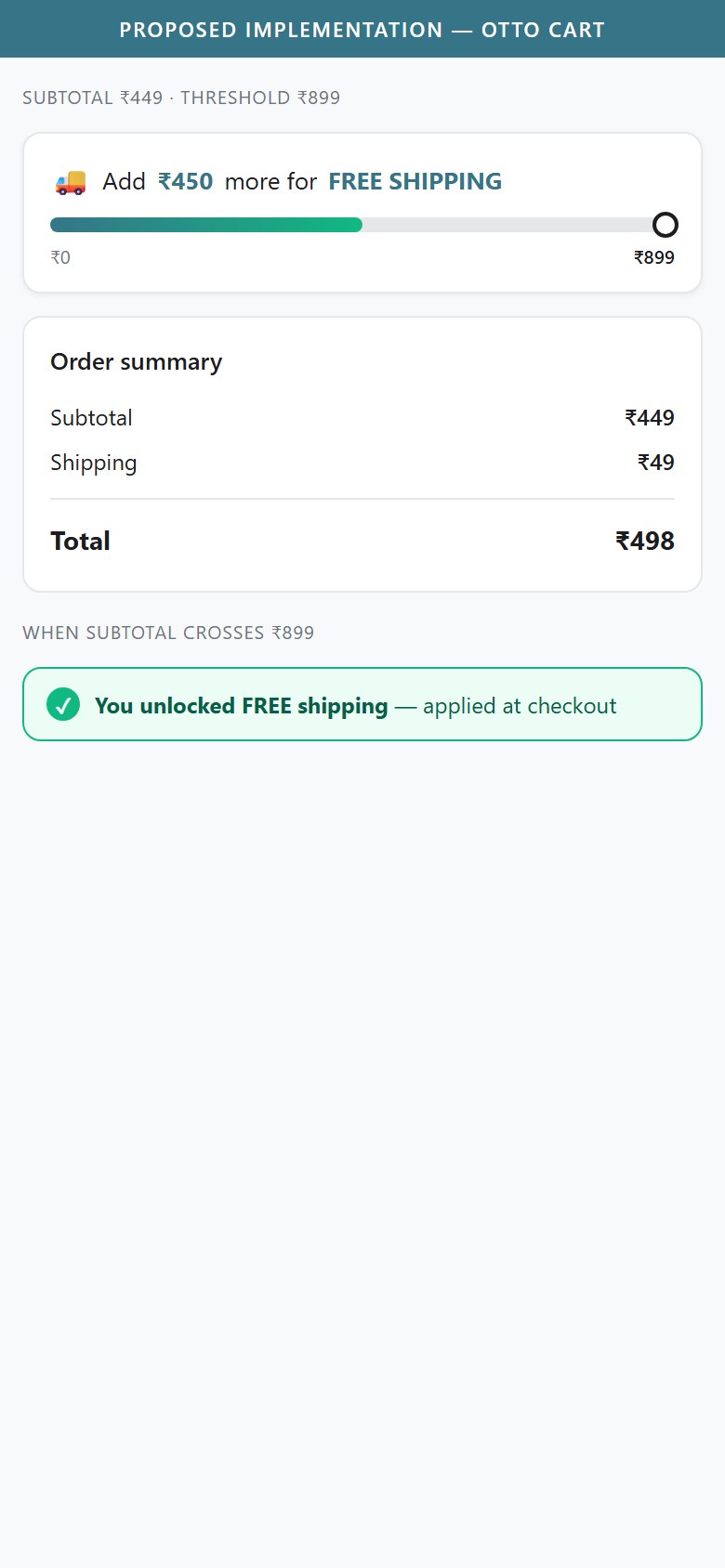
- Otto already runs a ₹899 free-shipping threshold (the policy exists), but neither the cart page nor the Gokwik overlay shows a progress bar or 'Add ₹X more for free shipping' message.
- When ATC items are below ₹899, the shopper has no incentive to add more — when above, they aren't reassured shipping is free.
- 6/10 benchmark stores expose threshold progress; in India fashion specifically, the leaders (Souled Store, Bewakoof) make it the cart's primary visual.
- Render a sticky progress bar at the top of the cart page: '₹450 more for FREE SHIPPING' with a fill bar driven by current subtotal vs ₹899.
- On crossing ₹899, swap to a green '✓ You unlocked free shipping' state — the positive confirmation reduces shipping-cost anxiety at checkout.
- Mirror the same bar inside the Gokwik cart drawer overlay so the message is consistent regardless of which surface the shopper hits.
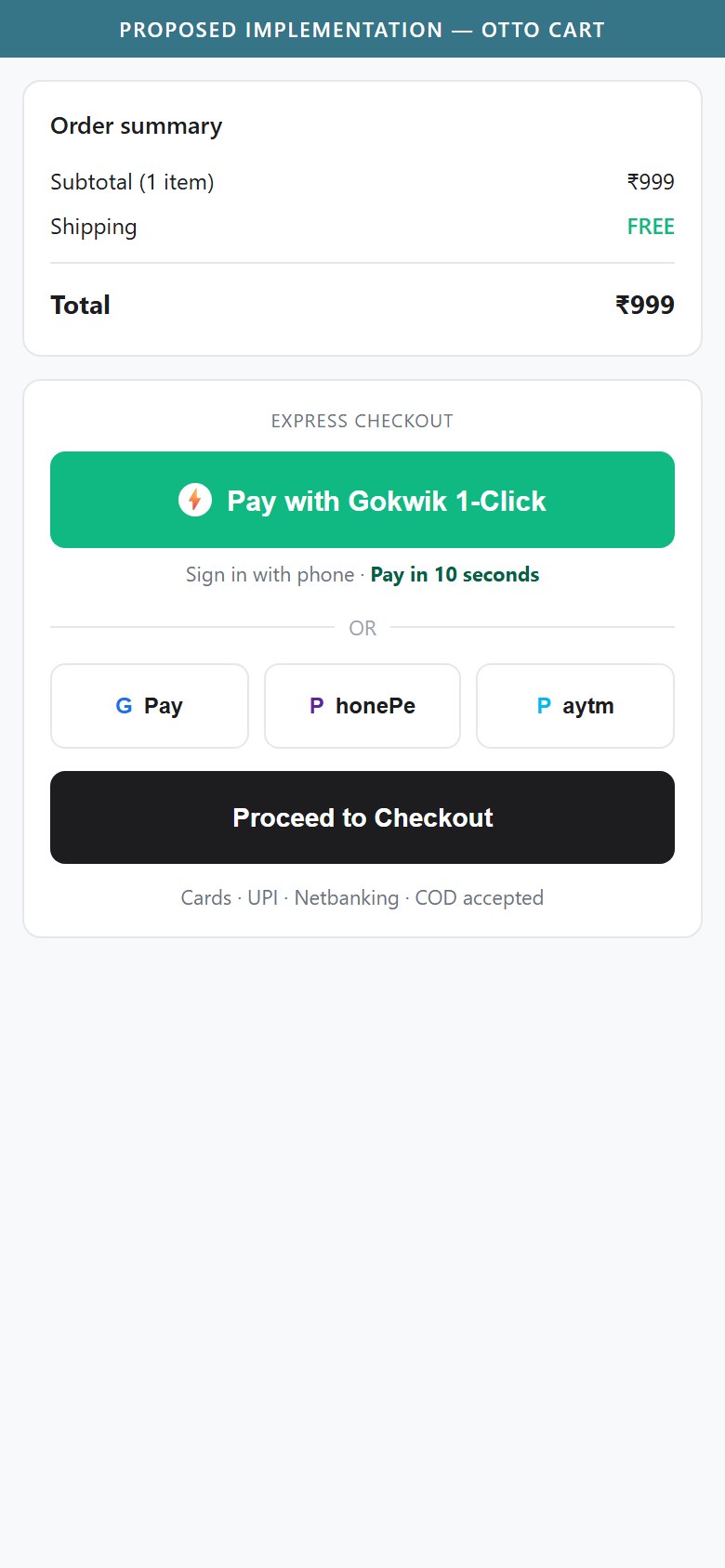
- Cart shows a single Checkout button — no Shop Pay, Google Pay, Amazon Pay, or visible Gokwik 1-Click button.
- Gokwik kwikpass is installed (mobile-OTP recognition), but the 1-Click affordance isn't prominently surfaced in the cart UI.
- Express checkout adoption is low industry-wide (1/10 in our broader sample) but India fashion leaders like Bewakoof prove it converts returning users 2-3x faster.
- Add a 'Pay with Gokwik 1-Click' button above the standard Checkout CTA — copy: 'Sign in with phone, pay in 10 seconds.'
- Stack Shop Pay (if Shopify Payments enabled) and Google Pay express buttons as a 3-tile row above the standard CTA.
- A/B test the express stack vs control — measure cart-to-purchase time and completion lift on returning shoppers.
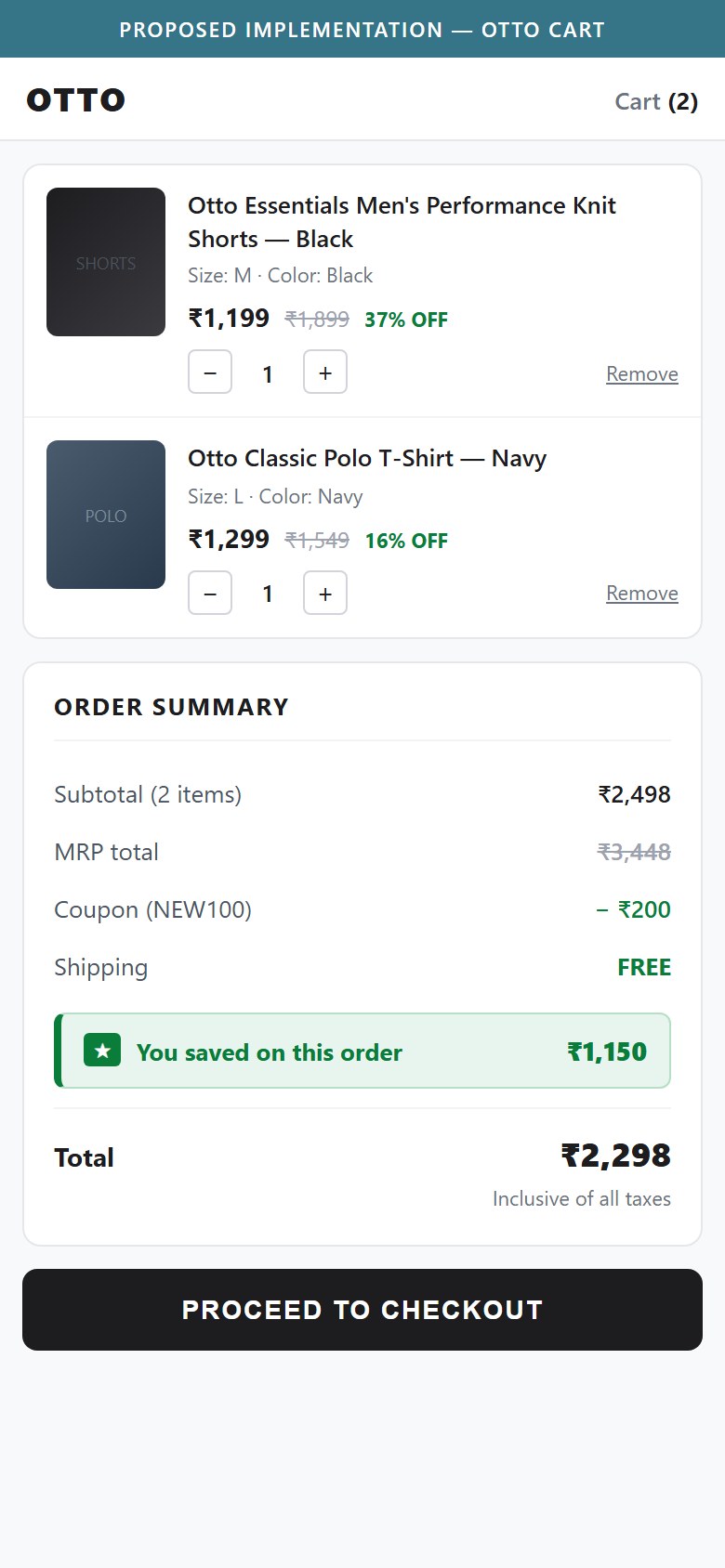
- The cart summary shows subtotal and shipping but no aggregate savings line — even though Otto runs strikethrough MRP-vs-selling-price on every SKU.
- Indian shoppers are highly anchored to MRP — a rolled-up 'You saved ₹X' line at the bottom of the summary monetizes that anchor at the conversion moment.
- Adding this is a copy + data change, no new infrastructure — savings = sum(MRP - price) across line items.
- Append a green 'You're saving ₹350 (22% off MRP)' line directly below the subtotal in the order summary block.
- Show the same total-savings line inside the Gokwik drawer overlay so shoppers see it whether they hit the drawer or the /cart page.
- Add a small 'Coupon applied: SAVE10 — ₹130 off' breakdown above the total savings when a code is in use, to validate that codes are working.
App Ecosystem
What's installed vs what's missing from best-in-class Fashion & Apparel stores
Present (5)
Missing (6)
App Stack Assessment
Otto's app stack covers the operational basics — Gokwik for checkout, Razorpay for payments, Judge.me for reviews, pincode checker for logistics — but underexploits conversion and AOV apps that India fashion leaders treat as baseline. Judge.me is installed but its rating data isn't surfaced where it converts (above-fold PDP, collection cards). Gokwik runs the checkout but its 1-Click affordance isn't elevated. There's no cart cross-sell, no free-shipping progress bar (even though the ₹899 threshold policy exists), no predictive search, and no loyalty program. Highest-leverage additions: (1) predictive search — 30-50% on-site search CVR lift, (2) cart cross-sell — 12-20% AOV lift, (3) surface the existing free-shipping threshold via a progress bar. These three alone close most of the gap to Bewakoof/Snitch.
Confidential — Prepared for Otto Clothing by Growisto | June 2026